- The Autonomous Age
- Posts
- I tried to kill my own company. Here's what I found.
I tried to kill my own company. Here's what I found.
Most founders defend their thesis. Few ever cross-examine it.

Amos Bar Joseph
March 25, 2026
I'm Amos, co-founder of Swan AI. I'm building the first autonomous business and documenting every step. $10M ARR per employee. No bloat. No theory. If that's not the game you're playing, reply to unsubscribe.
Nobody says this out loud.
Can Claude Code make my startup irrelevant by next quarter?
I spent two weeks trying to answer that honestly.
Not to reassure myself. Not to prep a response for investors. To actually find out.
Here's what I discovered: traditional moat analysis is useless in the AI application layer. When a foundation model can replicate any feature as a side effect, "what can we do" is the wrong question. The right question is "what can't they do without breaking themselves."
So I went looking. And I found three layers.
The first is UX.
Experience is always designed for someone. The question is how different your someone really is.
Claude Code is a developer tool. Always will be. Developers work proactively, you tell it what to build. GTM is the opposite. Reactive. Async. Running in the background while a rep responds to a hot lead at 11pm. You need pipeline views, task queues, campaign dashboards. Not a CLI. Could Anthropic build a GTM interface? Sure. But it means designing against their core UX DNA.
Real gap. Soft moat.
The second is tool orchestration.
The tooling layer is what connects your agent to the outside world. Commercial relationships, regulatory access, proprietary data if yours has real barriers, you have ground.
GTM runs on B2B data that lives behind paywalls. We're building commercial relationships with dozens of data providers so teams get any signal they need, one message away. That's not a feature. That's a business model. Harder to replicate but not impossible with enough capital and will.
Harder moat. Still soft.
The third is where it gets interesting.
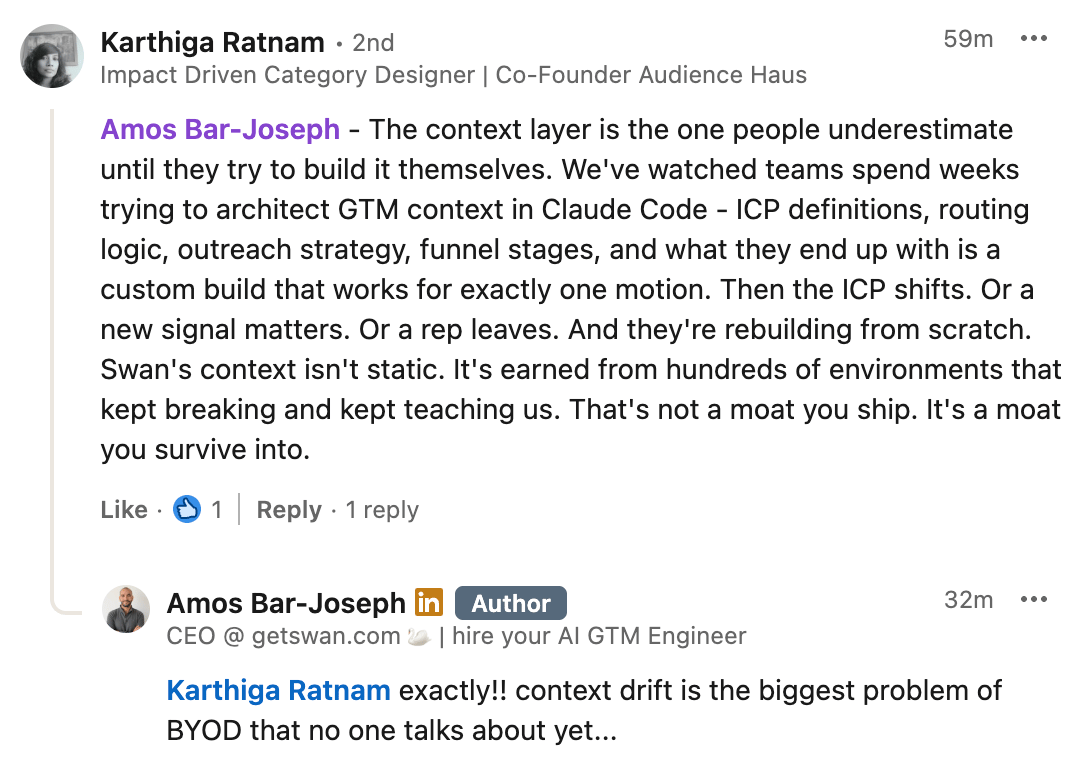
The context layer.
Every problem space needs its own knowledge architecture. How information is organized, compartmentalized, and structured for human+AI collaboration isn't universal, it's earned.
Claude Code starts empty. Generic. You architect everything yourself.
What components, what structure, how to maintain it as your GTM evolves. We already did that work. Hundreds of customers, battle-tested across real GTM environments. When you work with Swan, you're not getting a blank canvas. You're getting a system that already knows what GTM context looks like because we spent a year learning it the hard way.
Funnel stages. ICP definitions. Sender instructions. Routing logic. Outreach strategy.
That's not a feature gap. That's a knowledge gap. Switching costs on a battle-tested context model are enormous. And knowledge gaps don't close with a product update.
So can Claude Code make Swan irrelevant by next quarter?
Honestly, I don't know. The ground moves too fast to make promises. But I know which of our moats are soft and which ones are earned. And right now, that distinction is everything.

Can you hold the attack?
One question per layer. Answer honestly.
On UX: Is your user's workflow fundamentally incompatible with a general-purpose interface? If your user is niche with operationally distinct needs you have ground. A motivated team can't redesign their core UX DNA without breaking their existing users. If your user could plausibly switch to a CLI tomorrow, soft moat.
On Orchestration: Does your agent depend on data or relationships that can't be replicated with a product update? Commercial, regulatory, or scientific barriers are real. They take time and relationships to build not just code. If your tooling layer runs on publicly available APIs with no access barriers soft moat.
On Context: Have you built an opinionated knowledge architecture for your specific problem space? If yes, this is your compounding moat. Every customer interaction deepens it. Switching costs grow with every layer of context a customer builds inside your system. A new entrant starts from zero. If you're still working from a blank canvas, this is your highest-leverage build target. Start now.
Ask someone who wants you to fail. Their questions are better than yours.
You can't defend ground you've never tried to take from yourself.
-Amos
Community Notes

I’m Amos Bar Joseph, co-founder of Swan, the first Autonomous Business OS. At Swan, we’re building what we call the Autonomous Business: a company that scales to $10M ARR per employee with no bloat, no assembly lines, no Cog Culture. Just humans in their zone of genius, amplified by AI agents.